Commercial history of hard disk drives began with the IBM Model 350 disk storage with fifty 24" disks and a capacity of 5MBs in 1956. Their capacity has grown exponentially over time - that means 10 times capacity increase in each 5 years.
Today 1,000,000,000,000 bytes of capacity is provided by the world's first Terabyte Hard Drive: The Hitachi Deskstar 7K1000 with five 3.5" platters. At the suggested retail price of $399 it offers an impressive $0.39/gig ratio!
It is finally possible to store all of our favorite images, music and movies on one hard drive.
Friday, May 18, 2007


Wednesday, May 16, 2007
Peer-to-Peer Banking
Are you a better lender than a bank is? Do you need money to buy a new MacBook Pro?
Prosper and Zopa offers Internet Based Social Lending. They are an Ebay like online marketplace where people meet to lend and borrow money so that both parties can get a great deal. Social Lending is not new. It has been happening on a small-scale in families and social groups for hundreds of years – and the Network has opened it up to everybody.
The Social Futures Observatory has an interesting paper on the subject:
Internet Based Social Lending.
Prosper and Zopa offers Internet Based Social Lending. They are an Ebay like online marketplace where people meet to lend and borrow money so that both parties can get a great deal. Social Lending is not new. It has been happening on a small-scale in families and social groups for hundreds of years – and the Network has opened it up to everybody.
The Social Futures Observatory has an interesting paper on the subject:
Internet Based Social Lending.
Monday, May 14, 2007
The Roots of the Matrix
This video explains all the beliefs structures, religions beliefs, philosophies, etc. that are woven into the Matrix Trilogy. It uses the writers' and directors' own movie to show their alternate agenda. This is the Science Behind the Fiction.
"Right now, we're inside a computer program?
Is that really so hard to believe?"
What is the difference between reality and virtual reality?
"We think where we are where we have control over our sensory systems"
Some appearances:
"Right now, we're inside a computer program?
Is that really so hard to believe?"
What is the difference between reality and virtual reality?
"We think where we are where we have control over our sensory systems"
Some appearances:
- Kevin Kelly - Author, Out of Control: The New Biology of Machines, Social Systems and the Economic World
- Stephen Johnson - Author, Emergence: The Connected Lives of Ants, Brains, Cities, and Software
- Bruce Sterling


Wednesday, May 9, 2007
The Law of Accelerating Returns
Our world is accelerating. Most of us do not realize just how much so. The law of accelerating returns by Ray Kurzweil argues that technological change is exponential. In fact exponential growth is a feature of any evolutionary process, of which technology is a primary example. Besides the evolutionary process networking also drives this change.
The first technological steps - sharp edges, fire, the wheel - took tens of thousands of years. For people living in this era, there was little noticeable technological change in even a thousand years. By 1000 A.D., progress was much faster and a paradigm shift required only a century or two. In the 19th century, we saw more technological change than in the nine centuries preceding it. Then in the first twenty years of the twentieth century, we saw more advancement than in all of the nineteenth century. Today, paradigm shift occur in only a few years time.
What does this all mean? Many believes that this will lead to the Singularity.
The first technological steps - sharp edges, fire, the wheel - took tens of thousands of years. For people living in this era, there was little noticeable technological change in even a thousand years. By 1000 A.D., progress was much faster and a paradigm shift required only a century or two. In the 19th century, we saw more technological change than in the nine centuries preceding it. Then in the first twenty years of the twentieth century, we saw more advancement than in all of the nineteenth century. Today, paradigm shift occur in only a few years time.
What does this all mean? Many believes that this will lead to the Singularity.
Tuesday, May 8, 2007
A New Way to look at Networking
The Internet is based on the TCP/IP network with the assumption that its role is to provide conversation between two applications.
Security, mobility, ubiquitous computing, wireless, autonomous sensors, content distribution are all poorly served by what's available from either the research community or the marketplace. Van Jacobson argues in this Google Tech Talk that these problems go unsolved due to our tunnel vision and not because of their intrinsic difficulty. Simply changing our point of view may make many hard things easy.
Jacobson tells us a Brief History of Networking:
- Generation 1: the phone system (focus on the wires)
- Generation 2: the Internet (focus on the endpoints)
- Generation 3? dissemination (focus on the data)
- "Connected" is a binary attribute: you are either part of the internet and can talk to everythig or you are isolated.
- Connecting requires a globally known, unique IP address that's topologically stable on routing time scales (minutes to hours).
- Connecting is a heavy weight operation.
- The net doesn't like things that move.
- The transport protocols hate broadcast.
- Data is requested, by name, using any and all means available (IP, VPN tunnels, zeroconf addresses, multicast, proxies, etc.).
- Anything that hears the request and has a valid copy of the data can respond.
- The returned data is signed, and optionally secured, so its integrity and association with the name can be validated.
Monday, May 7, 2007
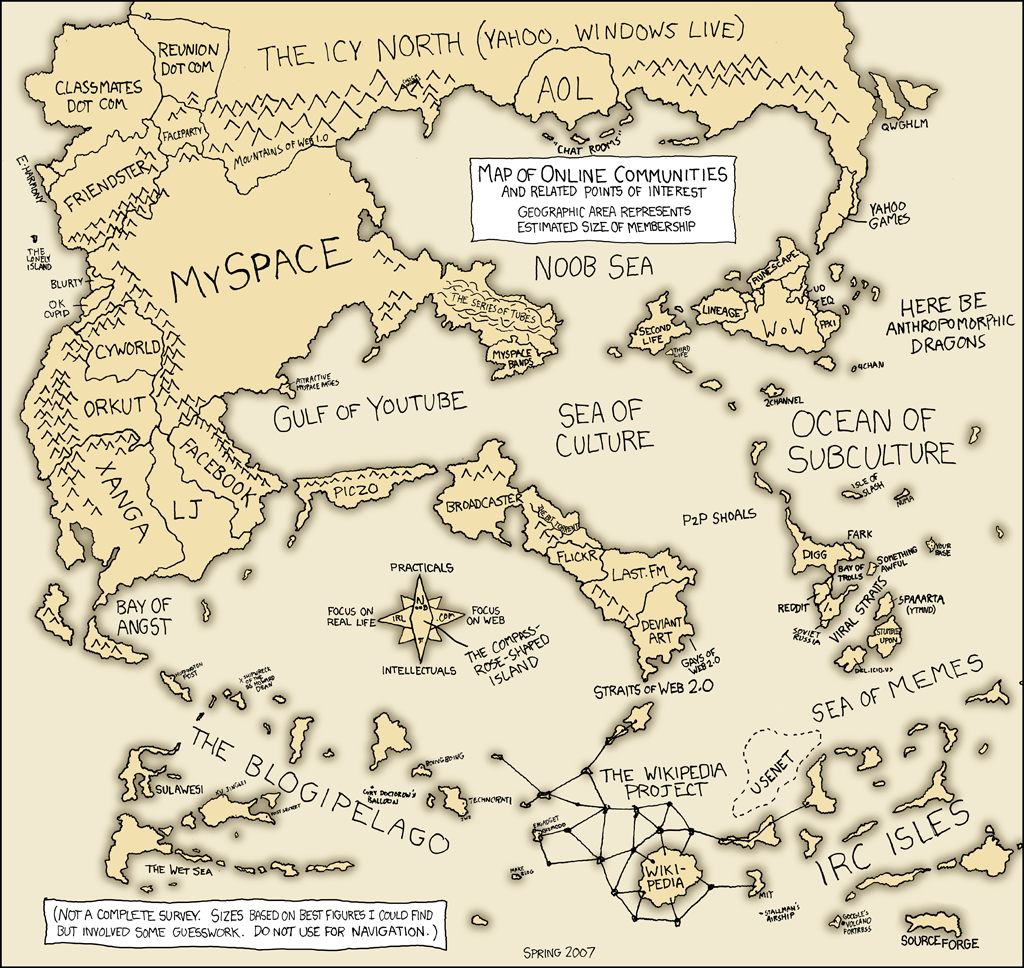
Map of Online Communities
xkcd has a nice map of online communities where the geographic are represents estimated size of membership. It even features a compass for navigation!

Thursday, May 3, 2007
Human Computation as a Business
Human Computation can solve Artifical Intelligence problems with the help of people.
Amazon.com has created a service based on human computation that can solve HITs (Human Intelligence Tasks) using micropayments.
Amazon.com has created a service based on human computation that can solve HITs (Human Intelligence Tasks) using micropayments.
- To learn how to submit work and have your tasks completed using the Amazon Mechanical Turk web service, visit the Amazon Web Services web site here.
- To make money by completing tasks, visit the Amazon Mechanical Turk.
Subscribe to:
Posts (Atom)


